Explaining Red Cows.
A Vietnamese meme turned out to be the most accurate frame for a weekend of fury over the two flags that still divide the Vietnam War’s winners and losers.

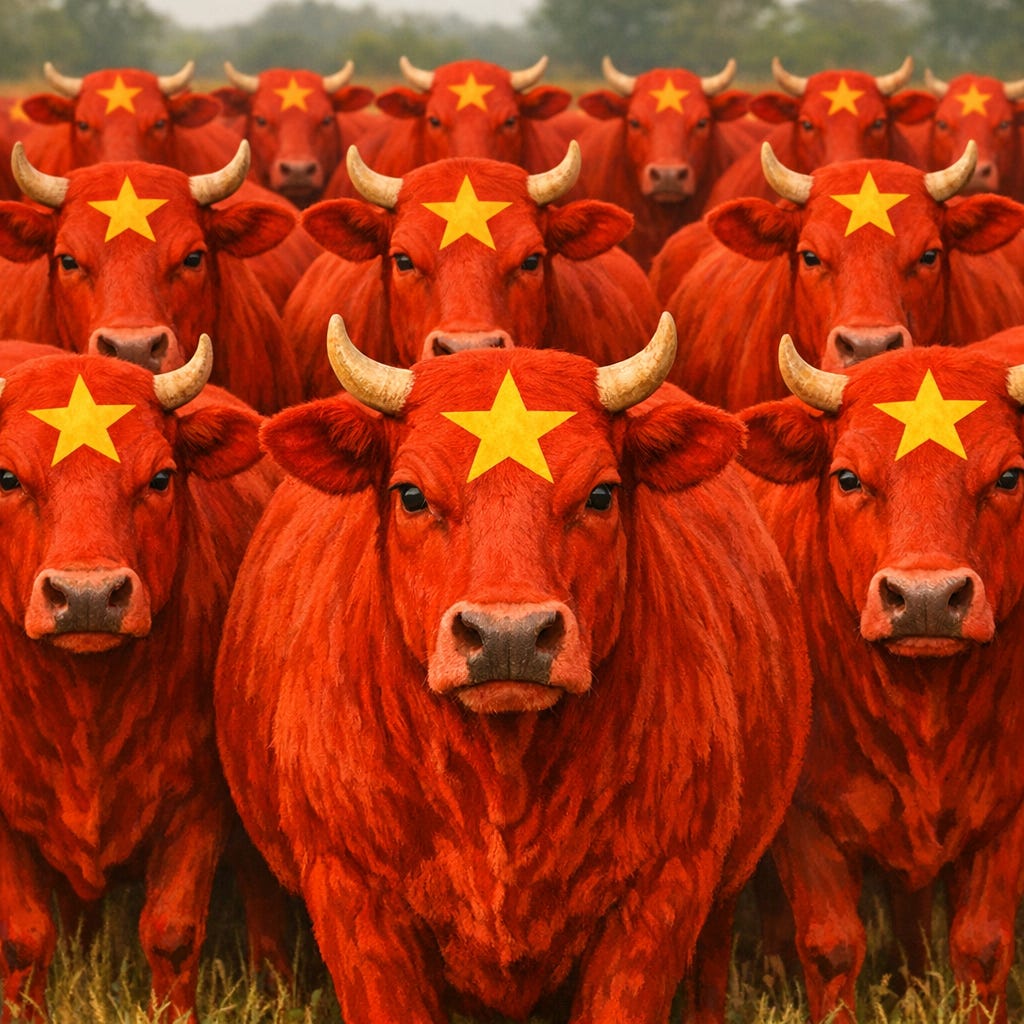
I realised, belatedly — more because I was chuckling at the ‘brilliance’ of my own headline, “The Red Cows of Melbourne,” than anything else — that it probably didn’t mean much to readers outside the small corner of the Vietnamese meme‑sphere where I first stumbled across the term six or eight months ago. “Bò đỏ” isn’t widespread slang in the diaspora, and hardly universal inside Vietnam either. I just liked the imagery the moment I saw it: a herd of bright red cows with yellow stars on their foreheads. It made me laugh, and it fit the behaviour I was trying to describe. But without that context, the phrase lands a little strangely.
Vietnam has no shortage of mass conformity, but few expressions of it are as revealing as the “Red Cow” — bò đỏ — a Vietnamese internet invention that tells you more about the country than any official slogan ever could. It began as a joke, a bit of Facebook satire aimed at the loud, patriotic brigade that swarms comment threads whenever Vietnam is mentioned. Like most good jokes, it stuck because it was true.
A bò đỏ is not a political category. It’s a behavioural one.
The “red” comes from the flag.
The “cow” comes from the herd.
The term was coined by anti‑state satirists on Facebook in the late 2010s, during the peak of the comment‑war era. Whenever a news story touched Vietnam — China, the South China Sea, a foreign arrest, a celebrity scandal — the same accounts would appear instantly, waving the flag, defending the state, and drowning out everyone else. Someone called them cows. Someone else coloured them red. A meme was born.
The meme pages that popularised it — Thông Não Bò Đỏ, Cà Khịa Bò Đỏ, and their many reincarnations — were repeatedly taken down. Each time, the images vanished with them, and the term never really travelled far beyond that echo system. It remained what it’s always been: a red cow with a yellow star on its forehead became shorthand for the reflexive, patriotic online voice of modern Vietnam.
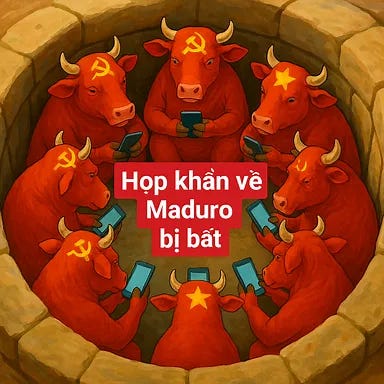
One of the last images before Thông Não Bò Đỏ disappeared was the red‑cow “emergency meeting” over Maduro’s kidnapping back in early January and if it’d now happen to Vietnam too. We ran it at the time. It still explains more than any official narrative ever did.
My own “Red Cow” moment wasn’t theoretical. It was those images — university‑age students waving the red‑and‑gold flag in front of a very recognisable Melbourne landmark, the Australian flag behind them, the whole scene looking like a meme I hadn’t even fully absorbed yet. I was still shaking off jet lag and catching up on what I’d missed over the International Dateline on 30 April, and suddenly there it was: the behaviour, the posture, the reflex. A Red Cow act in the wild.
For the first time, the two worlds were only blocks apart. The old diaspora marked 30 April outside Flinders Street Station, holding the yellow flag on their Day of Mourning. A short walk away, the overseas students were lined up in rows on the State Library steps — posing for photos, waving the red‑and‑gold flag, some later dancing in circles. One group carrying the banner of a country that no longer exists; the other raised on a curriculum where that flag is a footnote and the war is a morality tale with only one ending.
The first reaction came from the diaspora. Before the student clips even settled, the familiar lines were already rolling through Facebook: parents’ sacrifices questioned, scholarships invoked, warnings about forgetting where you came from, reminders that you can’t demonstrate like this back in Vietnam. Others pointed out the obvious — most of these kids weren’t returning home; they were here to work, settle, build new lives. Back-door immigrants. It was the standard diaspora script, triggered on cue.
The students weren’t answering back; they were just filming themselves the way they always do — drive‑bys, flag‑waving, group poses, the usual online swagger. Their clips were picked up immediately by the diaspora, reposted into Facebook groups where the familiar arguments lit up on schedule. By Saturday night the feeds were full of it: the Melbourne scenes refracted, memed, argued over, and stitched into a narrative none of the students had intended.
For me, the clip that stood out was the car‑full of students speeding past the yellow‑flag commemoration outside Flinders Street Station, phones up, all of them belting out the Võ Thị Sáu song like it was a road‑trip anthem. She is Vietnam’s Joan of Arc — a teenage martyr from the French era, now immortalised in schoolbooks and street names in every town. The singer in the passenger seat even threw in the grenade line — the martyr reborn but waiting for someone to hand her the weapon — before leaning out the window and yelling “fuck you” at the demonstrators (great manners, kids.) It wasn’t ideology. It was instinct, performance, and the kind of reflex you carry abroad without thinking.
Later, one of them wandered straight into the diaspora demonstration outside Flinders Street Station — arms out, jersey on, posing for the cameras — a perfect Red Cow photobomb. He was badly doxxed within hours. I’ll slip the picture in here; it says more about the day than any caption could.
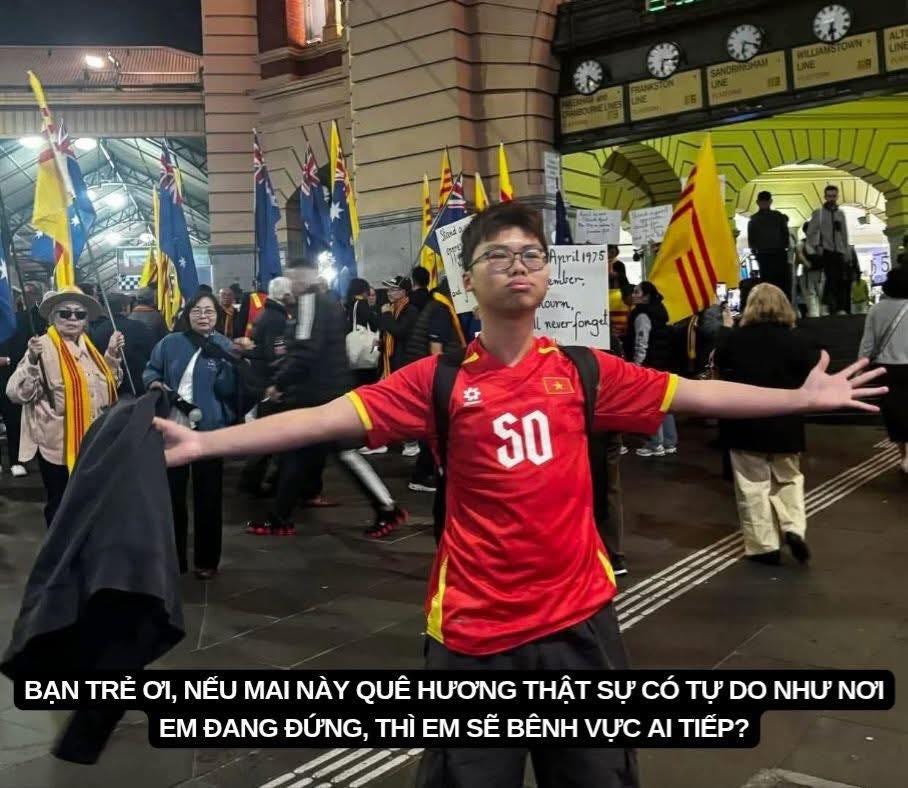
The caption circulating with the photo asked: “If Vietnam were free like Australia, who would you defend next?”
The diaspora responded in kind: outrage, doxxing, denunciations, and the familiar sense of betrayal that comes from watching the next generation speak a language you no longer recognise.
For the students, 30 April is still “Liberation Day.” For the diaspora, it’s the Fall of Saigon. They weren’t arguing about history; they were reenacting it.
By Monday, the whole thing had settled into its natural habitat: online. The Melbourne scenes were being pulled apart on Facebook, stitched into TikToks, reposted into diaspora groups around the world, and fed back into the same arguments that surface every 30 April. Memes, screenshots, denunciations, counter‑denunciations — the usual cycle.
Because the Red Cow is not just about communism. It’s about instinct. It’s about young Vietnamese who grew up in a country that tells a single story about itself, and who carry that story abroad without noticing. It’s about a diaspora who carry a different story, frozen in 1975, and who expect recognition that never comes.
The Red Cow description works because it captures the gap between those two worlds — the herd instinct, the certainty, the reflex. It’s absurd, but so was the weekend.
A herd of red cows staring straight at you is as good a metaphor as any for what happened in Melbourne: two histories, two identities, two sets of reflexes, briefly visible in the same city before disappearing back into their separate feeds.
Reconciliation still has a long way to go — and none of them seem in a hurry.
In the end, I’m the one calling them Red Cows. If it spreads, fine. The metaphor certainly fits.