
Hanoi keeps telling people to forget the past and look to the future. But the burden is always on everyone else — the South, the diaspora, the families who lived through re‑education camps, confiscations, and the boat people years. You’re the ones expected to forget the lackey slur, the prisons, the purges, the silence.
Yet the past they want erased isn’t your past at all. It’s theirs — the opportunism, the camouflage, the purges, the terror campaign, the takeover. “Forget the past” is not a call for reconciliation; it’s an attempt to bury the parts that expose how their present has been built.
Start with the “revolution” of August 1945. The Việt Minh didn’t defeat the Japanese. Tokyo surrendered. The administration evaporated. Hồ Chí Minh was simply quickest off his feet — first to seize the vacuum, grab the microphone, and declare a “revolution” that hadn’t actually happened. Opportunism dressed as inevitability.
And the Việt Minh didn’t represent the whole nation. They were a Marxist‑Leninist vanguard that had already begun purging rivals long before 1945. The “united fronts” were camouflage. The French had always found it easier to persecute the visible non‑communist nationalists, leaving the Việt Minh as the last organised force standing when the Japanese folded.
Meanwhile the South — messy, noisy, imperfect — was building a non‑communist political space with far more freedom than the North ever allowed. It had newspapers, parties, arguments, elections, and a public that didn’t whisper when politics came up. That’s why the South refused to sign Geneva. That’s why thousands of ex‑Việt Minh fled south. They had seen the system up close in the North — the surveillance, the purges, the land reform terror — and wanted nothing more to do with it. Two systems emerged after 1954, and only one of them was a one‑party state.
Here’s the part nobody ever says: The Vietnamese Communist Party wasn’t even officially there. It dissolved itself in 1945 to hide its identity. The French war was fought under the Việt Minh banner. The Party only re‑emerged in 1951 as the Workers’ Party — and didn’t reclaim the name “Communist Party of Vietnam” until after 1975, once the whole country was under one‑party control. The mythology came later.
And Hồ Chí Minh was never a universal hero. Not in the South. Not among the non‑communist nationalists. Not among the ex‑Việt Minh who fled south after seeing the system up close. The reverence was manufactured in the North — built through propaganda, purges, and a monopoly on narrative. In the South, he was remembered as the man who built a one‑party state, launched the terror campaign, and sent “volunteers” who were actually troops. Nobody in Saigon cheered his arrival in 1975. The mythology was regional, not national — and it became “national” only after dissent was silenced.
And the war itself carried a truth Hanoi never acknowledges: the North sent hundreds of thousands of young men south knowing full well most would never return. They were conscripts — farmers, students, boys pulled from villages and marched down the Trail into a meat grinder. The Party called it “liberation,” but it was attrition. Entire cohorts vanished. Families waited decades for news that never came. The South wasn’t fighting puppets; it was fighting a generation the North had already written off. The sacrifice was real, but the decision to spend them was political, not heroic.
The war in the South wasn’t spontaneous. It wasn’t “the people rising up.” It wasn’t an organic nationalist awakening.
It was Hanoi.
They launched the terror campaign. They cut off regions under coercive control. They assassinated village chiefs, teachers, policemen. They built shadow governments. They taxed, coerced, infiltrated. And denied having troops there — “volunteers,” they said. Everyone laughed.
Nobody cheered in Saigon in 1975. There was no liberation. There was takeover. Re‑education camps, confiscations, purges, boat people, silence, fear.
And even the Việt Cộng didn’t escape the aftermath. Once the war was won, many of the southern cadres — the ones who had carried the fighting, built the networks, taken the risks — were side-lined, demoted, or purged. They were useful during the war, but they were never trusted. Hanoi replaced them with northern cadres loyal to the Party, not to the South. The “liberators” were treated as a problem to be managed, not partners in victory. Another part of the past that never makes it into the official story.
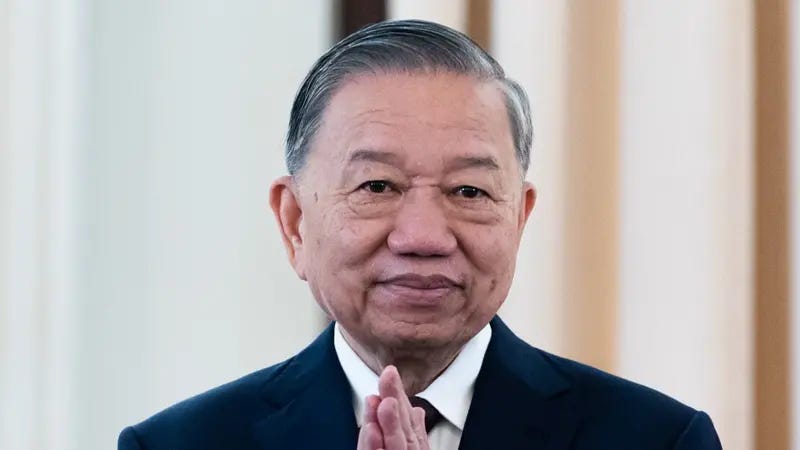
That’s the past Tô Lâm wants forgotten.
Because if people remember it clearly, the present — the police‑state machinery, the 331/117 reality, the summonses, the censorship, the fear — looks less like a deviation and more like continuity.
The past they want forgotten is the origin story of the present they refuse to name.
Spot on, Carl. Hitting the biggest nail on the head.