
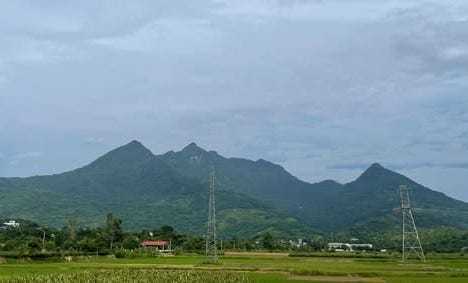
On a clear day in Hanoi — not that there are many now — you can see Ba Vì Mountain on the western horizon and feel the weight of Vietnam’s own creation legend. The Fairy Goddess Âu Cơ and her hundred eggs; fifty children to the mountains, fifty to the plains; later the origin of bánh chưng and bánh dày. Ba Vì is the spiritual root of the Vietnamese world. A sacred mountain. I’ve walked all the others — Fansipan, Yên Tử, Núi Bà Đen, Tam Đảo, Lũng Cú — long before the cable cars and the plazas. And now it’s the latest target of Vietnam’s largest tourism developer, the same outfit that has already stripped meaning from every other sacred mountain in the country, slapping “Eco” on each one as the concrete goes down.
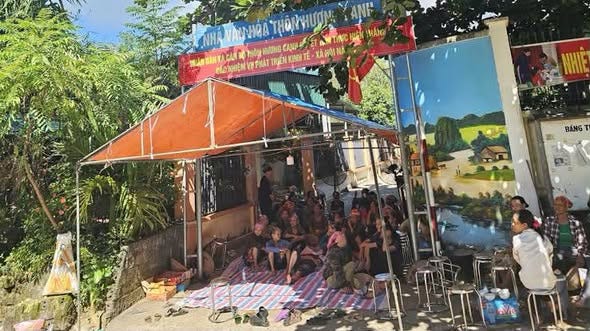
It’s happening right now. Sun Group calls it an “eco‑safari,” a 580‑hectare project pushed forward without competitive bidding and with a groundbreaking ceremony held before approval. The villagers saw the machinery coming and did what no one did at Fansipan or Núi Bà Đen or Yên Tử — they have pitched tents, blocked roads, and slept in shifts. They’re not waiting for the cable cars and plazas to arrive. They’ve watched what happened everywhere else. They know exactly what “Eco” means when a developer uses it in Vietnam.
Vietnam now builds tourism on a grand scale. See a mountain and run a cable car to the top. See a ridge and pour concrete until it looks like a plaza. Fake French towns, fake Italian cities, even a replica of Venice with gondolas down on Phú Quốc. The logic is always the same: bigger, louder, more spectacular. And people show up in droves — Vietnamese first, foreign tourists soon after — as if the spectacle itself justifies the destruction.
Worst of all is the monetised appropriation of Buddhism: Fansipan turned into a commercial shrine on the country’s highest peak; Yên Tử, where Vietnamese Zen began, now reached by cable car; and Núi Bà Đen, the Black Virgin Mountain northwest of Saigon, crowned with a massive smiling Buddha’s head gazing eastward, a mockery of everything the place once meant. And there’s more, lots more.
For the villagers, the issue isn’t mythology. It’s land. They were given access to the slopes and the base for farming, grazing, gathering wood, and the small economies that keep rural households afloat. Under “urgent measures,” that access is now being stripped away — fields fenced, paths blocked, machinery pushed in before approvals are final. What Ba Vì means to the country is one thing; what it means to the people who live under it is another. They’re not defending a legend. They’re defending the only ground they have.
We’ve just seen the same choreography in Hanoi. The Fatherland Front ran a “survey” on redeveloping the entire Hoàn Kiếm historic precinct, with officials looking over people’s shoulders house‑to‑house, and announced that 92% approved. Tô Lâm ordered the project to proceed.
It’s the same method now being used on Ba Vì: a 580‑hectare “eco‑safari” pushed forward without competitive bidding, a ground‑breaking ceremony planned before approvals are finalised, officials talking in hedged phrases about “urgent measures” and “development opportunities.” The pattern is identical. The only difference is that this time the villagers moved first.
And down on the Red River, the riverside redevelopment has been frozen mid‑stride — residents can’t repair, sell, or build, stuck in the same administrative limbo that now follows every major project.
Ba Vì won’t decide Vietnam’s future, but it shows the mood of the country right now. Land disputes everywhere, one hit with a 331. People don’t trust the process, they don’t trust the language, and they don’t believe the decisions are being made for them. Hoàn Kiếm proved that in the city centre. Ba Vì is proving it in the hills. If even the origin mountain can be folded into a development plan under “urgent measures,” then nothing is off‑limits. The villagers know that. Everyone knows that. The only question now is whether saying no this early makes any difference.
To be honest, as a local, I think I'm just as helpless as you are. No amount of reasoning is capable of getting into their "capitalist" heads, unless it's about money and benefits.
At the same time, if we don't do something, it's Son Doong Cave and Ha Long Bay next. Then, nothing natural left for the next generations.
It's a disaster. Pristine bays are being filled in for resorts. There is almost zero parkland in Hanoi. Not very much unique for Vietnam, but many places in Asia.