Return to Saigon in 1995.
Same‑same but different: my first return to Saigon twenty years after the Fall.

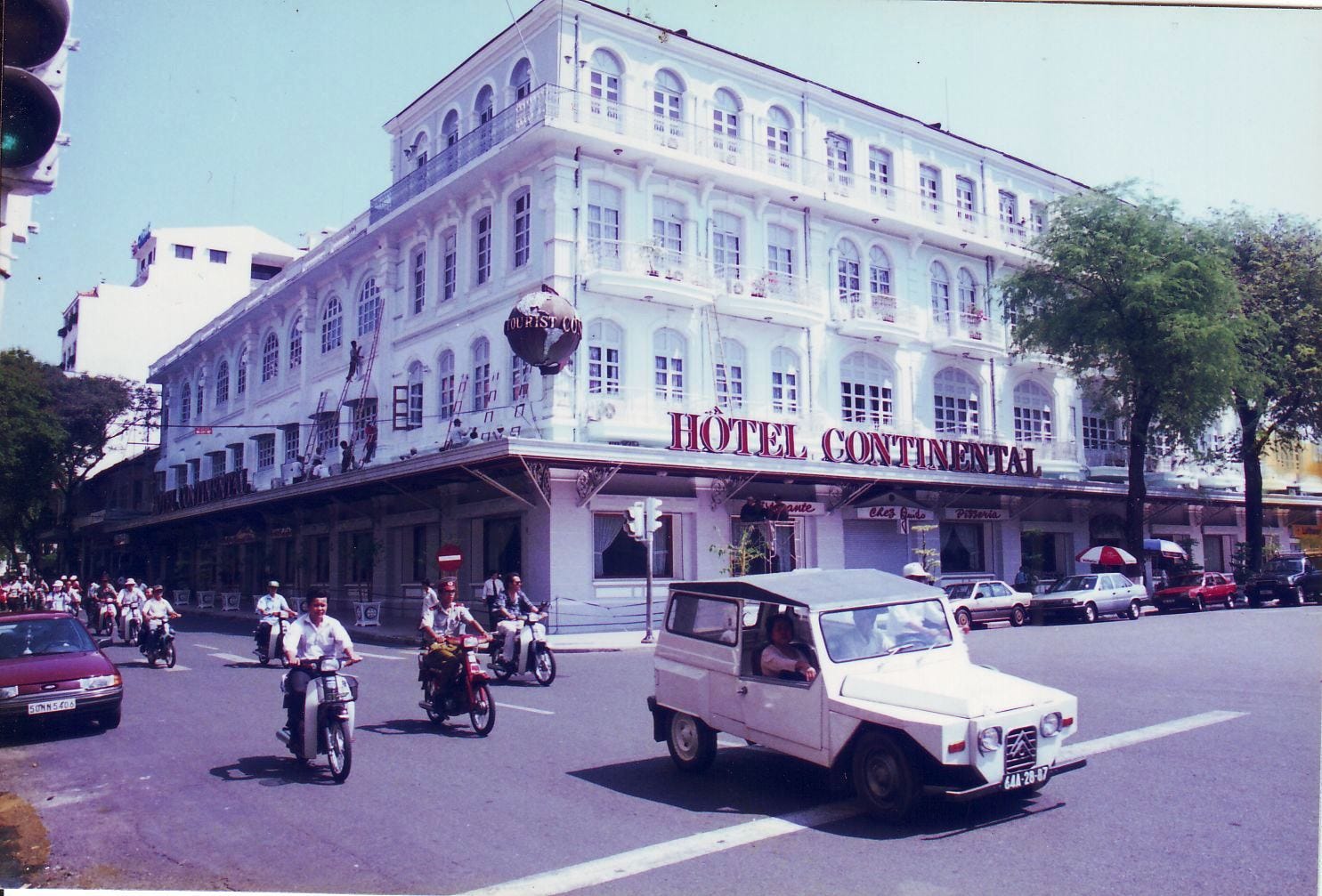
After our family reunion in Australia in 1985, I spent the rest of the decade with Newsweek and then — finally indulging a long‑held fantasy to show off my wife’s cooking — we opened our Vietnamese restaurant, the Old Saigon. Vietnam slipped into the background and I assumed I’d never return. But in April 1995, twenty years after leaving Saigon by helicopter, I went back for the first time — the first of many returns, as its turned out.
The article below is the piece I wrote then for The Bulletin, reproduced exactly as it ran. Some of my assumptions didn’t survive the next three decades, but that’s the risk of writing in the present tense — especially about a country where the same furniture tends not to move.
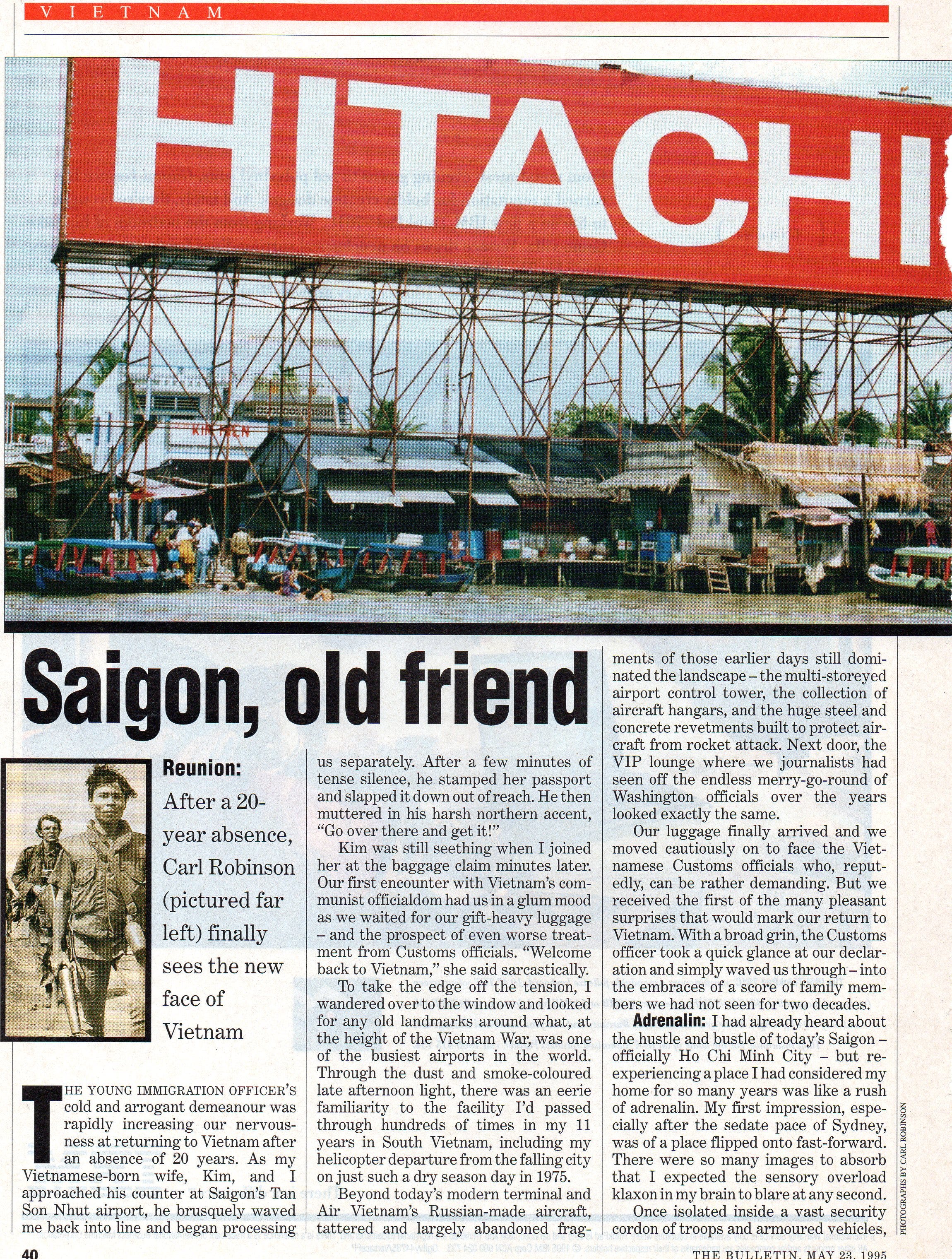
SAIGON, old friend.
By Carl Robinson*
The young immigration officer’s cold and arrogant demeanour was rapidly increasing our trepidation and nervousness at returning to Vietnam after an absence of 20 years. As my Vietnamese-born wife and I approached his counter at Saigon’s Tan Son Nhut airport, he brusquely waved me back into line and began processing us separately. After a few minutes of tense silence, he stamped her passport and rudely slapped it down noisily and out of reach around his side of the counter. He then muttered in his harsh northern accent, “Go over there and get it!”
Kim-Dung was still seething with anger when I joined her at the baggage claim a few minutes later. Our first meeting with Vietnam’s communist officialdom had both of us in a glum mood as we waited for our gift-heavy luggage – and the prospect of even worse treatment from Customs officials. “Welcome back to Vietnam,” she said sarcastically. “If that’s how we’re going to be treated here, we might as well go straight back to Sydney.”
To take the edge off the tension, I wandered over to the window and looked for any old landmarks around what, at the height of the Vietnam War, was one of the busiest airports in the world. Through the dust and smoke-coloured late afternoon light, there was an eerie familiarity to the facility I’dl passed through hundreds of times in my 11 years in South Vietnam, including my precipitous helicopter departure from the falling city on just such a dry season day in 1975.
Beyond today’s modern terminal and Vietnam Airlines Russian-made aircraft, now-tattered and largely abandoned fragments of those earlier days still dominate the landscape – the multi-storied airport control tower, the collection of aircraft hangars, and the huge steel and concrete revetments built to protect aircraft from rocket attack. Next door, the VIP lounger where we journalists had seen off the endless merry-go-round of Washington officials over the years looked exactly the same.
Our luggage finally arrived and we moved cautiously on to face the judgement of Vietnamese Customs officials who –- reputedly – can be rather demanding. But instead, we received the first of many pleasant surprises that would mark our return to Vietnam. With a broad grin, the customs officer took a quick glance at our declaration and waved us through. Our black moods lifted just as quickly as we walked out into the embraces of a score of family members we’d not seen for two decades.
I’d already heard about the hussle and bustle of today’s Saigon – officially Ho Chi Minh City – but re-experiencing the reality of a place I had considered my home for so many years was like a rush of adrenalin. My first impression, especially after the sedate pace of my adopted Sydney, was of a place flipped onto Fast-Forward. There were so many images to absorb that I expected the Sensory Overload klaxon in my brain to flare at any second.
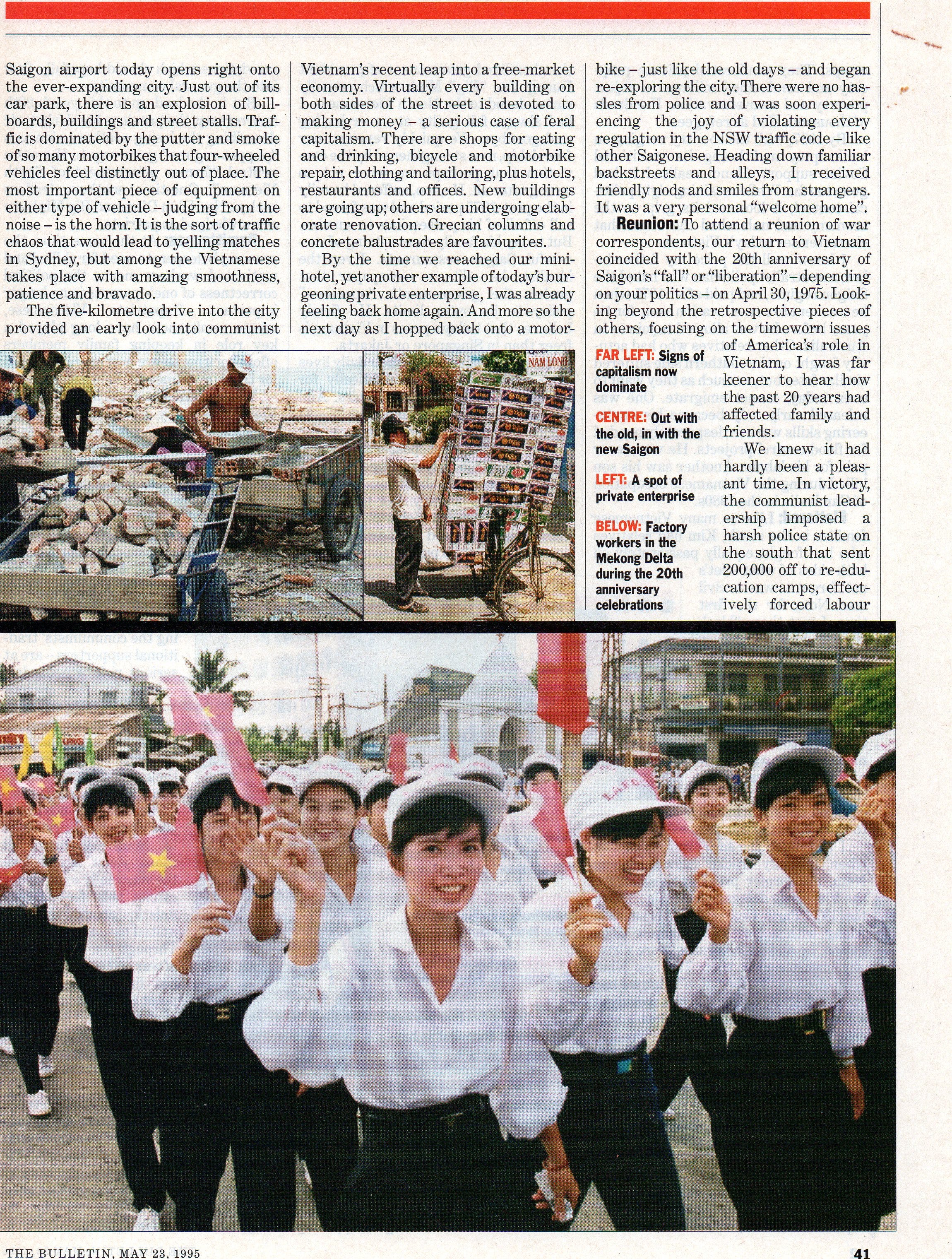
Once isolated inside a vast security cordon of troops and armoured vehicles, Saigon airport today opens right onto the ever-expanding city. Just out of its car park, there is an explosion of billboards, buildings and street stalls. Traffic is dominated by the putter and smoke of so many motorbikes that four-wheeled vehicles feel distinctly out of place. The most important piece of equipment on either type of vehicle – judging from the noise – is the horn. It’s the sort of traffic chaos that would lead to shootings in L.A. and yelling matches in Sydney, but among the Vietnamese takes place with amazing smoothness, patience and bravado.
The five-kilometre drive into the city provides an early look into communist Vietnam’s recent leap into a free-market economy. Virtually every building on both sides of the street is devoted to making money – a serious case of Feral Capitalism. There are shops for eating and drinking, bicycle and motorbike repair, clothing and tailoring, plus full-sized hotels, restaurants and company offices. New buildings are going up while others are undergoing elaborate expansion or renovation. Graecian columns and concrete balustrades are particular favourites.
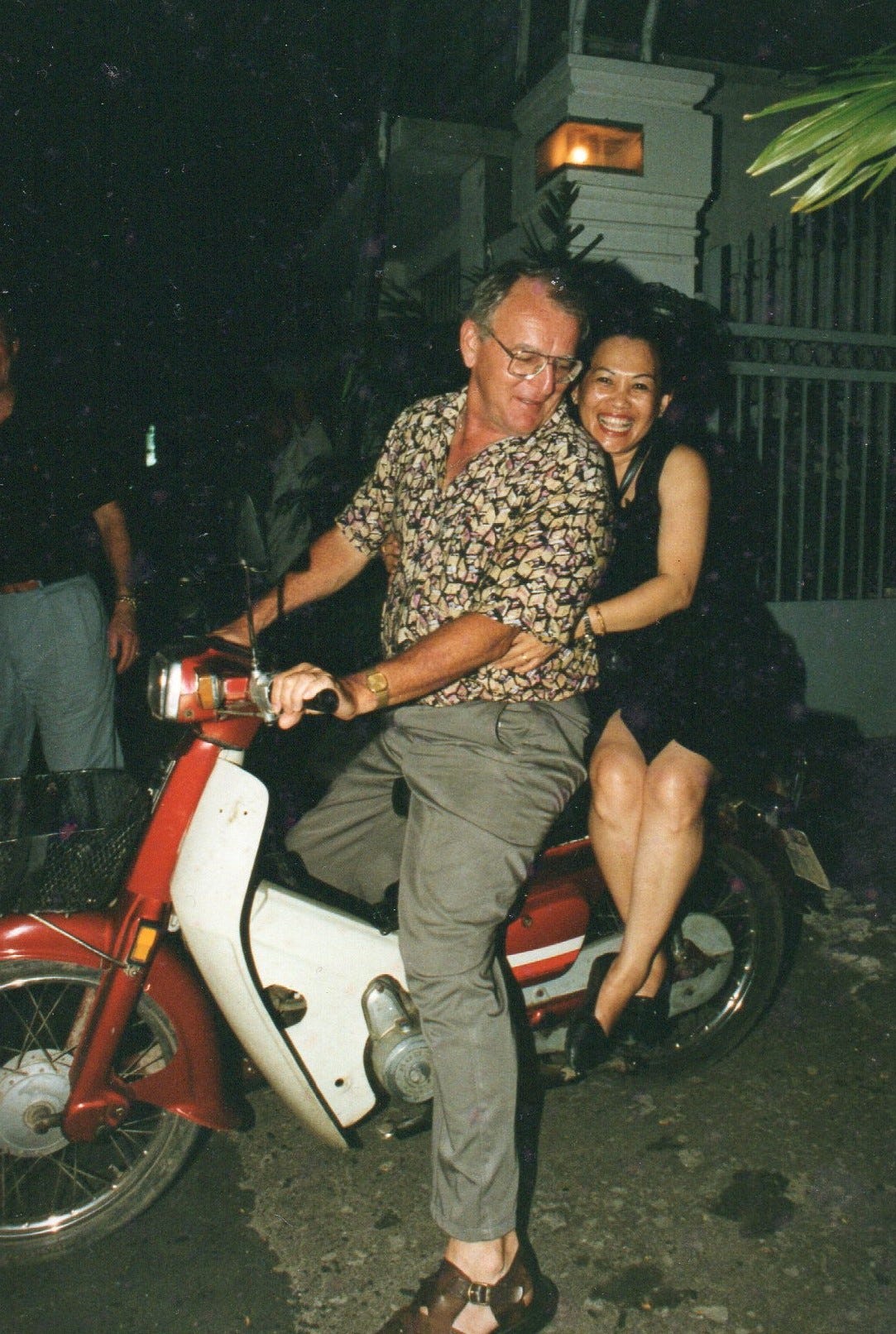
By the time we reached our mini-hotel, yet another examples of today’s burgeoning private enterprise, I was already feeling back home again. And more so the next day as I hopped onto a motorbike – just like the old days – and began re-exploring the city. There were no hassles from police and, like other Saigonese, I was soon experiencing the joy of violating every regulation in the NSW traffic code. Heading back down familiar back streets and alleys, I received friendly nods and smiles from total strangers. It was a very personal “welcome home.”
To attend a reunion of war correspondents, our return to Vietnam coincided with the 20th anniversary of Saigon’s “Fall” or “Liberation” – depending on your politics – on 30 April 1975. Looking beyond others’ retrospective pieces focusing on the time-worn issues of America’s role in Vietnam, I was far more keen to hear how the past 20 years had affected family and friends.
We knew it had hardly been a pleasant time. In the flush of their victory, the communist leadership imposed a harsh police state on the south that sent 200,000 off the re-education camps, effectively forced labour camps. They confiscated private property and sent millions into abject poverty and near-starvation. Hundreds of thousands fled as refugees. By 1987, with the country verging on bankruptcy and losing its traditional Soviet support, Hanoi realised it had gone too far. While retaining its rigid political control, it loosened its grip on the economy and unleashed the boom that now characterises today’s Vietnam.
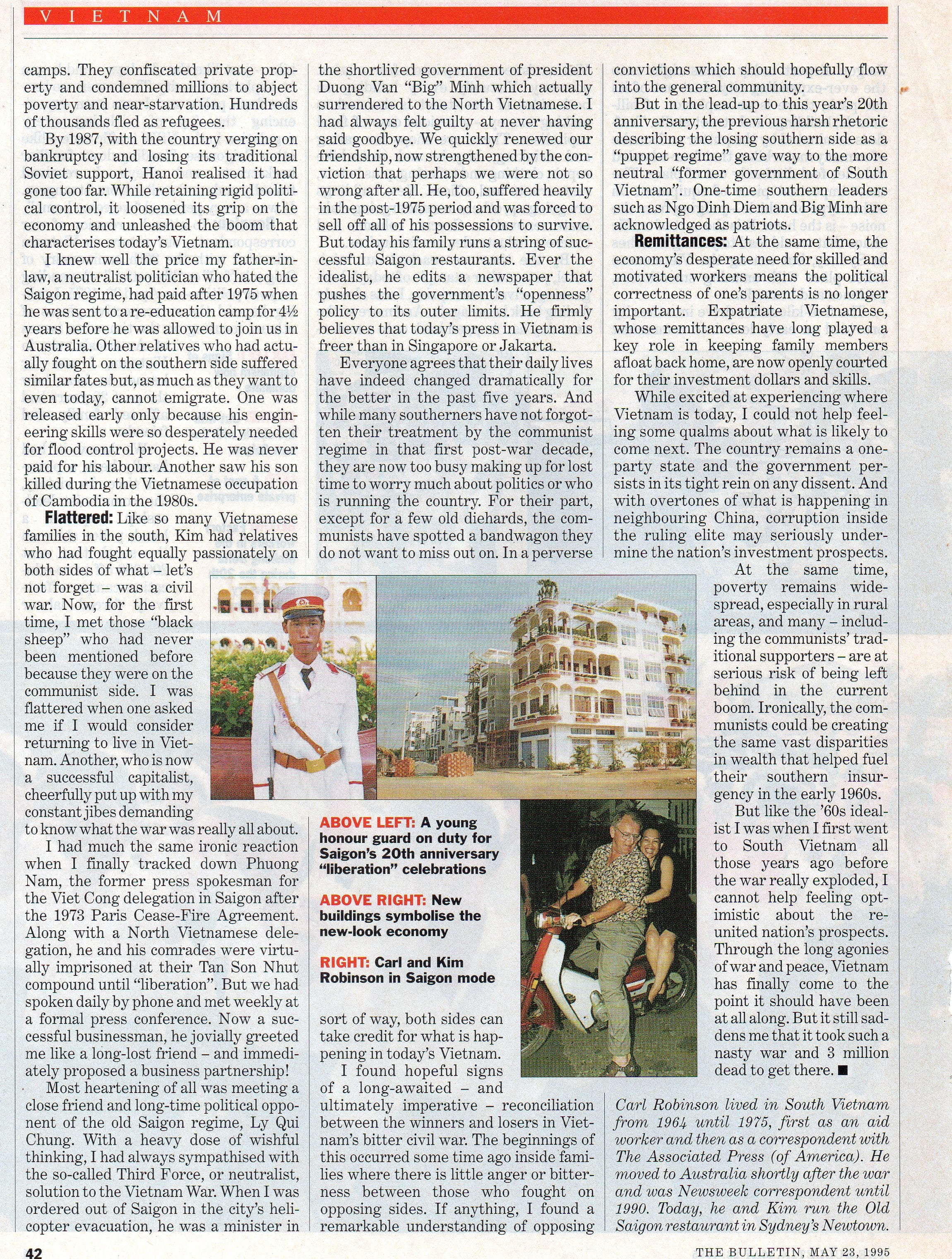
I knew well the price my own father-in-law, a neutralist politician who hated the Saigon regime, had paid after 1975 when he was sent to a re-education camp for four and a half years before he was allowed to join us in Australia ten years after the Fall. Other relatives who’d actually fought on the southern side suffered similar fates but, as much as they want to even today, cannot emigrate. One was only released early because his engineering skills were so desperately needed for flood control projects. He was never paid for his labour. Another saw his son killed during Vietnam’s occupation of Cambodia in the 1980’s.
Like so many Vietnamese families in the south, Kim-Dung had relatives who’d fought equally passionately on both sides of what – let’s not forget – was a civil war. Now, for the first time, I met those “black sheep” who were never even mentioned before because they were on the communist side. I was flattered when one asked me if I’d consider returning to live in Vietnam. Another, who is a successful capitalist, cheerfully put up with my constant jibes demanding to know what the war was really about.
I had much the same ironic reaction when I finally tracked down Phuong Nam, the former press spokesman for the Viet Cong delegation in Saigon after the 1973 Paris Cease-Fire Agreement. Along with a North Vietnamese delegation, he and his comrades were virtually imprisoned at their Tan Son Nhut compound until “Liberation.” But we had spoken daily on the phone and met weekly at a formal press conference. Now a successful businessman, he jovially greeted me like a long-lost friend – and immediately proposed a business partnership!
But most heartening of all was meeting up with a close friend and long-time political opponent of the old Saigon regime, Ly Qui Chung. With a heavy dose of wishful thinking, I’d always sympathised with the so-called Third Force, or neutralist, solution to the Vietnam War. When I was ordered out of Saigon by the AP in the city’s helicopter evacuation, he was Information Minister in the short-lived government of President Duong Van “Big” Minh which actually surrendered to the North Vietnamese. I’d always felt guilty at never having said goodbye.
We quickly renewed our earlier friendship, now strengthened by the conviction we weren’t so wrong after all. He, too, suffered heavily in the post-1975 period and was forced to sell off all of his possessions, including his wife’s prized piano, to survive. But today, his family runs a string of successful Saigon restaurants. Ever the idealist, he edits a free-wheeling newspaper that pushes the government’s “openness” policy to its outer limits. Very little is sacrosanct, he says, and he firmly believes that today’s press in Vietnam is more free than Singapore or Jakarta.
Everyone agrees that their daily lives have indeed changed dramatically for the better in the past five years. And while many southerners have not forgotten their treatment by the communist regime in that first post-war decade, they are now too busy making up for lost time to worry much about politics or who is running the country. For their part, except for a few old die-hards, the communists have spotted a bandwagon they don’t want to miss out on. In a perverse sort of way, both sides can take credit for what’s happening in today’s Vietnam.
Indeed, I found hopeful sings of a long-awaited – and ultimately imperative – reconciliation between the winners and losers in Vietnam’s bitter civil war. The beginnings of this process began some time ago inside families where there is little anger or bitterness between those who fought on opposite sides. If anything, I found a remarkable understanding of opposing convictions which should hopefully flow into the general community.
But in the lead-up to this year’s 20th anniversary, the previous harsh rhetoric describing the losing southern side as a “pupped regime” gave way to the more neutral “former government of South Vietnam.” Former southern leaders such as Ngo Dinh Diem and Big Minh are acknowledged as patriots. Even this year’s rather bland “liberation parade” in downtown Ho Chi Minh City seemed deliberately designed not to provoke any bad feelings among the Vietnamese.
At the same time, the economy’s desperate need for skilled and motivated workers means the political correctness of one’s parents is no longer important. Overseas Vietnamese, whose remittances have long played a key role in keeping family members afloat back home, are now openly courted for their investment dollars and skills.
While clearly excited at seeing and experiencing where Vietnam is today, I couldn’t help feeling some qualms about what’s likely to come next. The country remains a one-party state and the government continues a tight rein on any dissent. And with overtones of what’s happening in China, corruption inside the ruling elite could seriously undermine the nation’s investment prospects.
At the same time, poverty remains widespread, especially in rural aress, and many – including the communists’ traditional supporters – are at serious risk of being left behind in the current boom. Ironically, the communists could be creating the same vast disparities in wealth which help fuel their southern insurgency in the early 1960’s.
But like the sixties idealist I was before I first went to South Vietnam all those years ago before the war really exploded, I can’t help feeling optimistic about the reunited nation’s future prospects. Through the long agonies of war and peace, Vietnam has finally come to a point it should have been all along. But it still saddens me that it took such a nasty war and three million dead to get there.
*Carl Robinson lived in South Vietnam from 1964 to 1975, first as an aid worker and then as a correspondent with The Associated Press (of America). He moved to Australia shortly after the war and was Newsweek correspondent until 1990. Today, he and his Vietnamese wife Kim-Dung run the popular Old Saigon restaurant in Sydney’s Newtown.
Time and memory. Another good one, thanks