
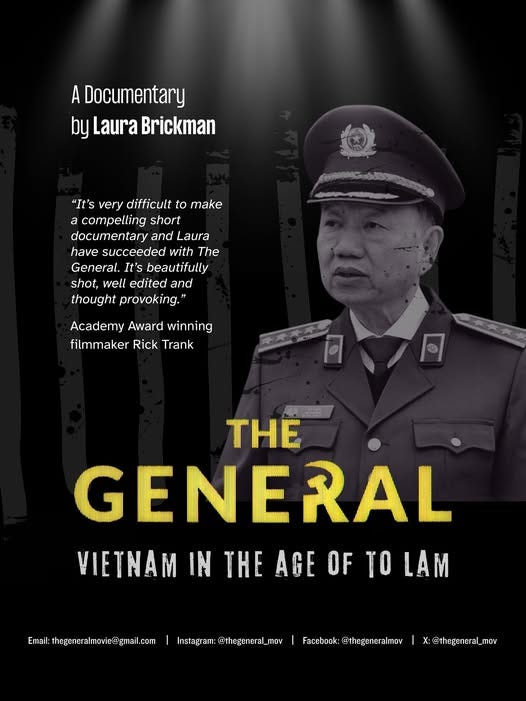
Long accustomed to the droning boredom of Vietnam’s decades‑long “collective leadership” model — a one‑party system so stable it barely registered in conversation during my many returns to the country where I spent the war years — I’ve only really snapped awake in the past eighteen months. The sudden, almost indecent rise of communist party hard‑liner Tô Lâm has made Vietnam’s internal machinery impossible to ignore. Who is this man, exactly, and what’s his bloody hurry?
And I was already paying closer and closer attention, writing here for months — wondering whether Vietnam was edging into something more Stalin‑esque, quietly flipping to Xi’s China model, watching one dissident go down in real time on Facebook, even poking holes in the “tiger economy” narrative everyone keeps pushing to reassure foreign investors.
Then, from inside the Vietnamese diaspora, I heard about a documentary called The General: Vietnam in the Age of Tô Lâm, by a journalist I’d never heard of — Laura Brickman, American or maybe Aussie — and was instantly intrigued at the thought of someone else out there mapping the same terrain. I tracked down its Facebook page, watched the trailer, noted its Virginia premiere, and then read the stunning review by dissident lawyer Đặng Đình Mạnh, who called it “a muffled scream from within.” After that, I had to see it — and when I discovered it was screening around Australia, I drove up to Sydney.
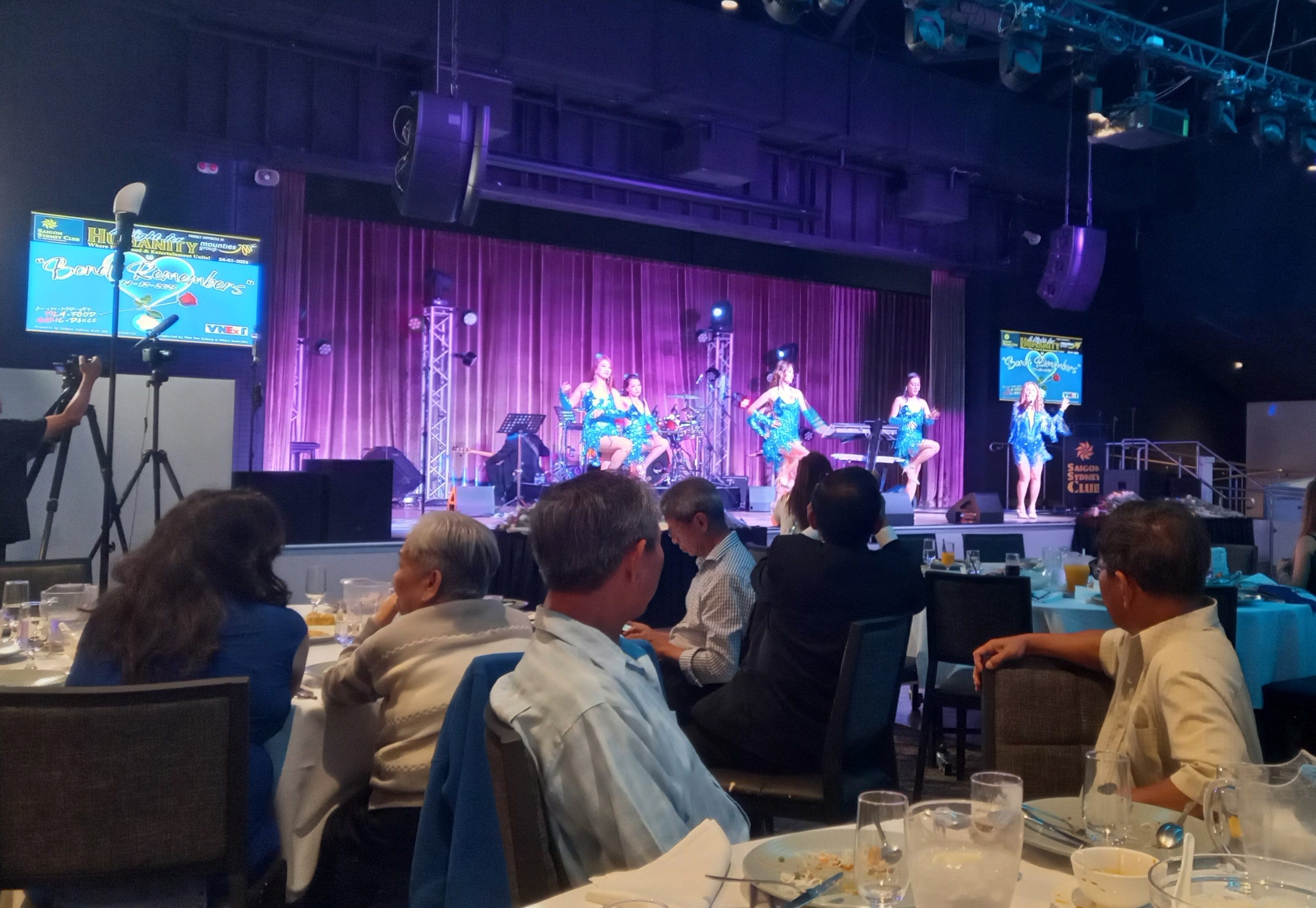
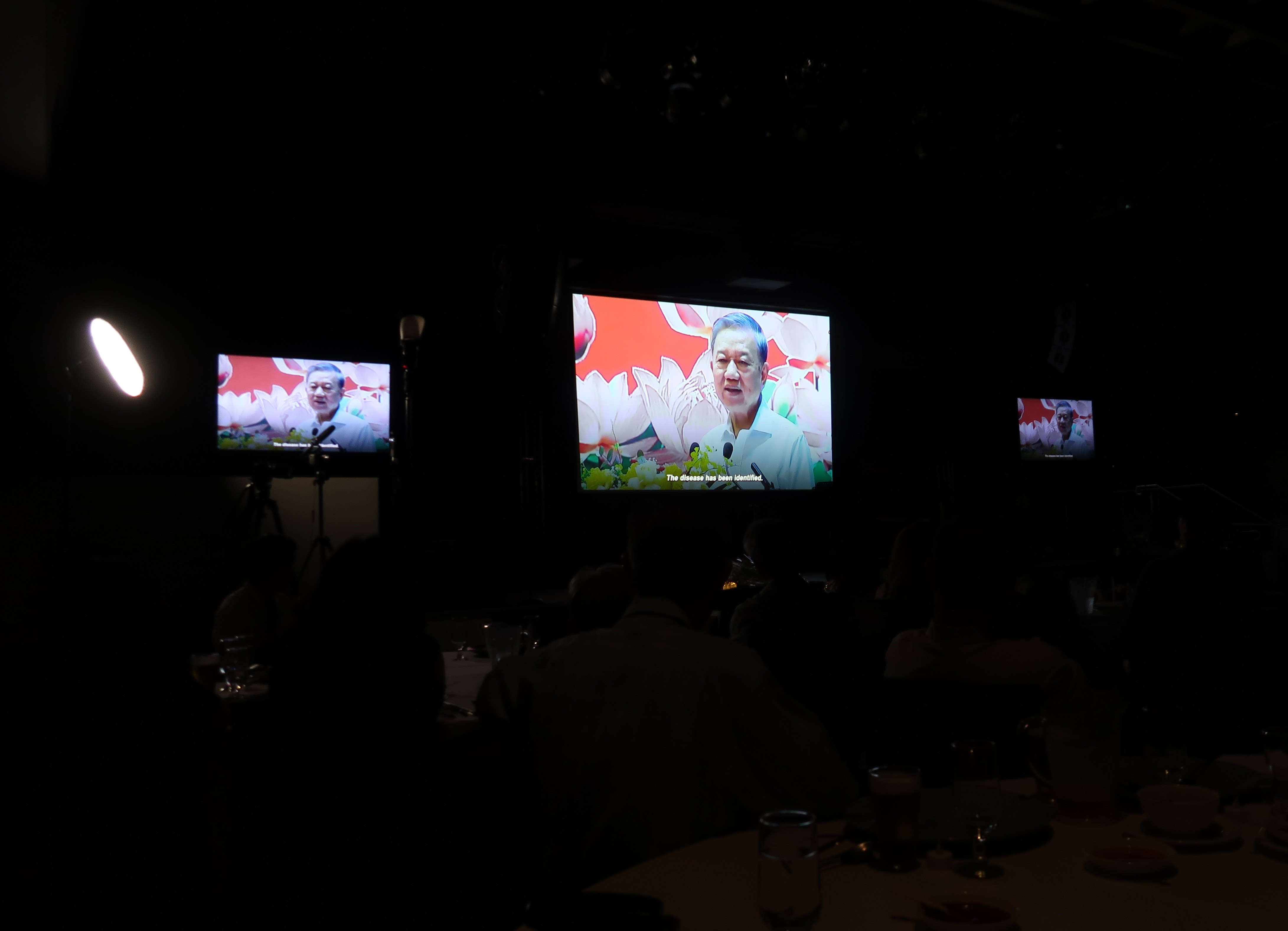
The setting couldn’t have been more Australian‑diaspora ordinary: the film was folded, almost off‑handedly, into a grand charity night at Mounties, a western Sydney pokie club — “A Night for Humanity,” complete with a tribute to the Bondi massacre victims and a full program of song and dance still to come. Viet Tân — the diaspora group Hanoi insists on calling a terrorist organisation — was the sponsor.
There weren’t many white faces in the room — maybe three of us in a crowd of 300 Vietnamese — just Laura Brickman herself and a just‑met Aussie with a Vietnamese wife who’d lived in early‑2000s Vietnam and had no idea what he was about to see. It was the kind of community evening where songs from the old Saigon days, a bit of dancing — and maybe a charity auction — usually carry the night, and yet here, tucked between the formalities, was a documentary about the rise of Tô Lâm and the people crushed in his wake.
It came early in the program — after the Australian and old Republic of Vietnam (South Vietnam) anthems, a few speeches, and a round of entrées — and I was keen for the film. Most people in the room seemed to have no idea what The General was; and more there for the song‑and‑dance program afterwards. But for me, this was the main event.
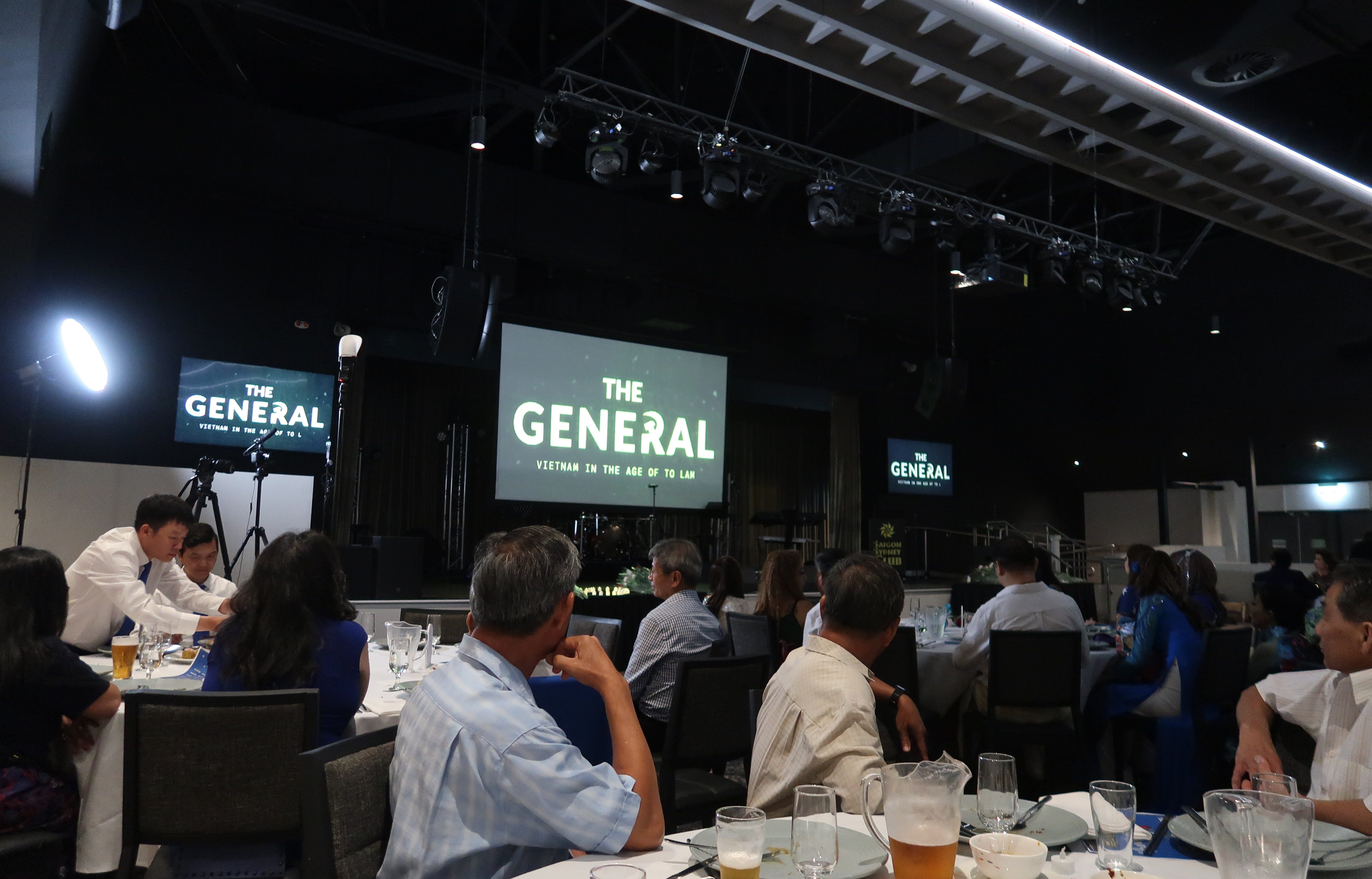
The General opens with a jolt: the dramatic arrest of a Vietnamese dissident, the camera shaking as bodies collide, and then a hard cut to black as everything hits the ground. It’s an abrupt, disorienting beginning, and it tells you exactly what kind of story you’re about to watch — one where the state’s violence is not theoretical but physical, intimate, and always just off‑screen.
Brickman then cuts to the official imagery of Saigon’s 50th‑anniversary parade — Russian helicopters dragging enormous flags across the sky, cannons firing in choreographed bursts — the spectacle I’d seen myself last April, though in a far less sinister register, just cynical. The juxtaposition is deliberate: the state’s over-the-top pageantry on one side, the bodies of dissidents hitting the ground on the other.
From those opening moments, The General widens its frame into something sprawling and strangely intimate. It isn’t tidy or tightly argued; it moves in wide arcs, doubling back, letting voices accumulate until a picture forms almost by sediment. But the emotional through‑line is unmistakable: a security state seen through the people it breaks. Brickman doesn’t editorialise, and she doesn’t need to — the testimonies, the footage, the quiet exhaustion in people’s faces do the work. For someone who’d only recently started paying attention again, it felt like an unfiltered download.
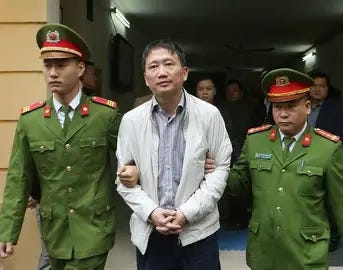
The story really begins with the Trịnh Xuân Thanh kidnapping in Berlin in July 2017 — the narrative peg Brickman keeps circling back to, and for good reason. The whole episode had been above my radar at the time: Thanh was a corrupt operative at state‑run PetroVietnam who’d sought political asylum in Germany before Vietnamese agents snatched him off a Berlin street and hauled him back to Hanoi, where he later appeared on television to say he’d returned voluntarily, publicly tried and then sentenced to two life sentences.
Among many in the diaspora, the reaction was a familiar one — a sense that whatever Germany thought about sovereignty, Thanh himself hardly inspired sympathy, much less a real refugee. But the film treats that moment not as a morality play about one man, but as the hinge: the point where Vietnam’s security apparatus stopped pretending, and where Tô Lâm’s rise became impossible to ignore.
From there, the film walks through the forensics of the abduction with an almost procedural calm: the surveillance footage, the honey‑trap element, the choreography of cars and operatives, and then the unexpected Slovakian detour. Then-Minister of Public Security Tô Lâm — in black uniform too, no less — had just visited Bratislava; a Vietnamese adviser inside the Slovak government smoothed access; Prime Minister Fico’s office approving the Slovak government jet — routed through Russia — carried Thanh out. It’s the kind of detail that would sound far‑fetched if it weren’t documented.
Brickman also tracks the immediate blowback: Vietnamese agents began targeting diaspora journalists reporting on the case, including Lê Trường Khoa, editor of a major Vietnamese‑language news site. Berlin froze relations, and Hanoi eventually traded its way out by releasing human‑rights lawyer Nguyễn Văn Đài — founder of the Brotherhood for Democracy, sentenced to 15 years — who joined Khoa in Germany, where both have remained thorns in Hanoi’s side ever since, even as they were later sentenced in absentia under Article 117.
Beyond the Thanh case, the film sketches the wider architecture of Tô Lâm’s Vietnam: the tightening of speech, the environmental wreckage folded into the so‑called economic miracle — most starkly central Vietnam’s 2016 Formosa steel disaster, which poisoned hundreds of kilometres of coastline and displaced entire fishing communities, and brought a wave of arrests for the environmentalists and community defenders who tried to document it — and the way foreign governments have looked past the worsening rights climate in pursuit of trade.
She also notes how the tone shifted abroad as well: Obama at least kept human rights in the conversation, however lightly, while under Trump the subject vanished altogether, giving Hanoi even more room to harden its stance.
When Tô Lâm was filmed in London eating a gold‑encrusted steak at Salt Bae’s restaurant, the clip went everywhere — a security chief luxuriating in a meal worth months of a worker’s salary. Back in Saigon, a noodle‑shop owner was hauled in and fined for naming one of his dishes after the same chef. The message was unmistakable: the powerful can gorge in private; the public can’t even joke about it.
Brickman threads in voices from across the map: dissidents in Thailand, artists in the U.S., and activists inside Vietnam recording what amount to last‑will statements before their arrests — some of the most poignant moments in the film — all describing the same machinery from different angles. She also touches on the domestic costs of the “economic miracle”: land grabs that have pushed poor and minority communities aside, and the steady pressure on anyone who tries to document them.
And she keeps returning to contemporary Germany, where Khoa and Đài now live under quiet police protection, their reporting and advocacy still needling Hanoi years after the kidnapping that brought them there. Taken together, these strands give the film its breadth — a portrait of a security state whose reach extends far beyond its borders, and of the people who continue to push back from exile.
By the end credits, as the long list of imprisoned names and sentences scrolls grimly past — lawyers, ordinary people, journalists, artists — the film’s sprawl makes a different kind of sense. Sure, it could use a tighter edit and a little less reliance on the western talking heads, but that’s a matter of structure rather than substance. And all of it feels even more immediate now that, just a day before the Sydney screening, the XIV Party Congress handed Tô Lâm a full five‑year term.
Seeing it with an audience, and catching up with Brickman — US-born, only 30 and already covered Asia, Ukraine and now Israel — reminded me how vital it is to keep bringing these present‑day realities to the world’s attention, and how necessary it is to continue with what Laura, many others, and myself are doing. Good to see the next generation picking up the thread too.
I didn’t catch much of the audience reaction — I’d pulled Laura outside for a chat by then — but my sense, from the fragments I did see, was of a room slightly stunned by the scale of it all. Vietnam’s security machinery is a long way from their daily lives here, where people can dance, argue, and post online without looking over their shoulders. And even from afar, the reach isn’t entirely abstract — what they can so easily read on Facebook about the documentary is already blocked inside Vietnam, a small reminder of how far the pressure extends.
I am a young Vietnamese, living in Vietnam at the moment. I heard about the this movie, but don’t know how to approach it. Thank you for telling your story, and summarizing some key scenes of the film.